The terror doesn't leave when the threat does.
You probably already know that.
I didn't start therapy with a plan.
I didn't walk into the room thinking, here's what I need to work on.
Mostly, I just knew that something was wrong — always wrong — and that living with constant fear and distraction wasn't sustainable anymore.
That's it. That was the whole reason.
If you've been waiting for a more compelling reason to start — or to go back, or to try harder — I want you to know: that's enough. That quiet, persistent sense that something isn't right? That's enough.
If you've lived through trauma, you probably know what I mean when I say the terror stays long after the threat is gone.
It sounds like you've gotten good at carrying it. Functioning. Showing up. Looking mostly fine from the outside.
It seems like there are days when you can almost forget it's there — and then something small, something that shouldn't matter, pulls the floor out from under you.
It looks like you've tried things. Maybe therapy. Maybe not. Maybe you've read books, listened to podcasts, done the breathing exercises. Some of it helped. Some of it didn't. And you're still here, still carrying the same weight, still wondering when it actually gets lighter.
That's not failure. That's what trauma does. It makes your nervous system very, very good at staying on guard — long after the guard is necessary.
Here's what nobody tells you about living with a traumatic past:
It doesn't just affect how you feel. It affects how you decide.
It affects your career. The risks you don't take. The opportunities you doubt yourself out of. The roles you stay in too long because survival instincts are running the show instead of clarity.
It affects your relationships. Who you let close. How much of yourself you actually show up with. How much you keep locked away — not because you want to, but because vulnerability still feels like a trap door.
It affects how you interpret ordinary anxiety — making normal uncertainty feel like genuine danger.
Trauma doesn't stay in the past. It moves into your present and rearranges the furniture. It changes what looks safe and what looks dangerous. And it does this so quietly, so thoroughly, that eventually you stop noticing it's doing it at all.
It isn't.
The hard part isn't deciding to heal.
The hard part is that healing is slow, uneven, and profoundly unglamorous.
It's not a breakthrough. It's erosion.
It's showing up week after week to sit in a chair — sometimes saying something meaningful, sometimes talking about fruit you can't find in your neighborhood. It's walking out of sessions feeling hollowed out — stomach heavy, brain tired, chest tight — and not being sure whether that means it's working or whether you just made things worse.
Nobody tells you that the silence at the beginning of a session — your therapist looking at you, waiting — never fully gets comfortable.
Nobody tells you about the grief. Not just grief for what happened. Grief for the version of yourself that never got to exist. For the years spent surviving instead of living. For the decisions made from fear, the opportunities doubted away, the relationships kept at a careful distance.
That grief is real. It's valid. And it has to be felt before it can release.
I want to address something before we go any further.
You might be thinking: This is just one person's experience. What does it have to do with me?
Fair. My history is specific. I was robbed for the first time at seven years old. I can account for more than twenty muggings — most of them in the two years I spent in public middle school. There was sexual abuse. Witnessing attempted murder. Being shot at in my own home. A high-rise apartment fire. And more.
Your history is different. Maybe less dramatic by count. Maybe more. Maybe quieter — but just as devastating.
Trauma isn't a competition. The feeling it leaves behind — that haunting sense that something is permanently wrong, that danger is just one step behind you, that you are never quite safe — that feeling is the same regardless of the source.
You might also be thinking: I've tried things like this before. They didn't help.
I understand that. The healing space is full of content that sounds right but feels empty — a lot of language about "journeys" and "wholeness" and "deserving peace" that doesn't match the experience of actually being in that room, in that chair, trying to find words for something you've been carrying for decades.
This isn't that.
This is an account. Specific. Honest. Written from inside the experience — not from a clinical distance. The silence, the hangovers, the slow erosion of fear, the grief, the rebuilding, the moments where it suddenly, quietly gets lighter.
And finally: Is a $27 PDF actually going to do anything for me?
Honestly — this guide is not therapy. It will not replace therapy. I say so clearly on the first page and I mean it.
What it might do is give you something I wish I'd had at the beginning: a realistic, specific account from someone who has been in the chair a long time, who has done the work, who has come out the other side not fixed — but genuinely free. That might give you hope. It might help you get more from your sessions. It might be the thing that gets you to make the first appointment.
If it does any of those things, it was worth it.
My name is J. Douglas Cohen.
I am not a therapist. I have no initials after my name. No credentials in mental health.
What I have is this: decades of lived experience with trauma, and many years of serious, committed therapy — including a stretch where I was in session three times a week for a full year.
I turned down pharmaceuticals more than once. Not out of stubbornness — well, not only stubbornness — but because I knew at my core that what was broken in me wasn't a natural chemical imbalance. It was an unnatural one, induced by experience.
I held onto that belief. I dove in. And slowly — not dramatically, not cinematically, more like watching erosion happen — things shifted.
One random day I realized I wasn't looking over my shoulder anymore.
This guide is what I learned.
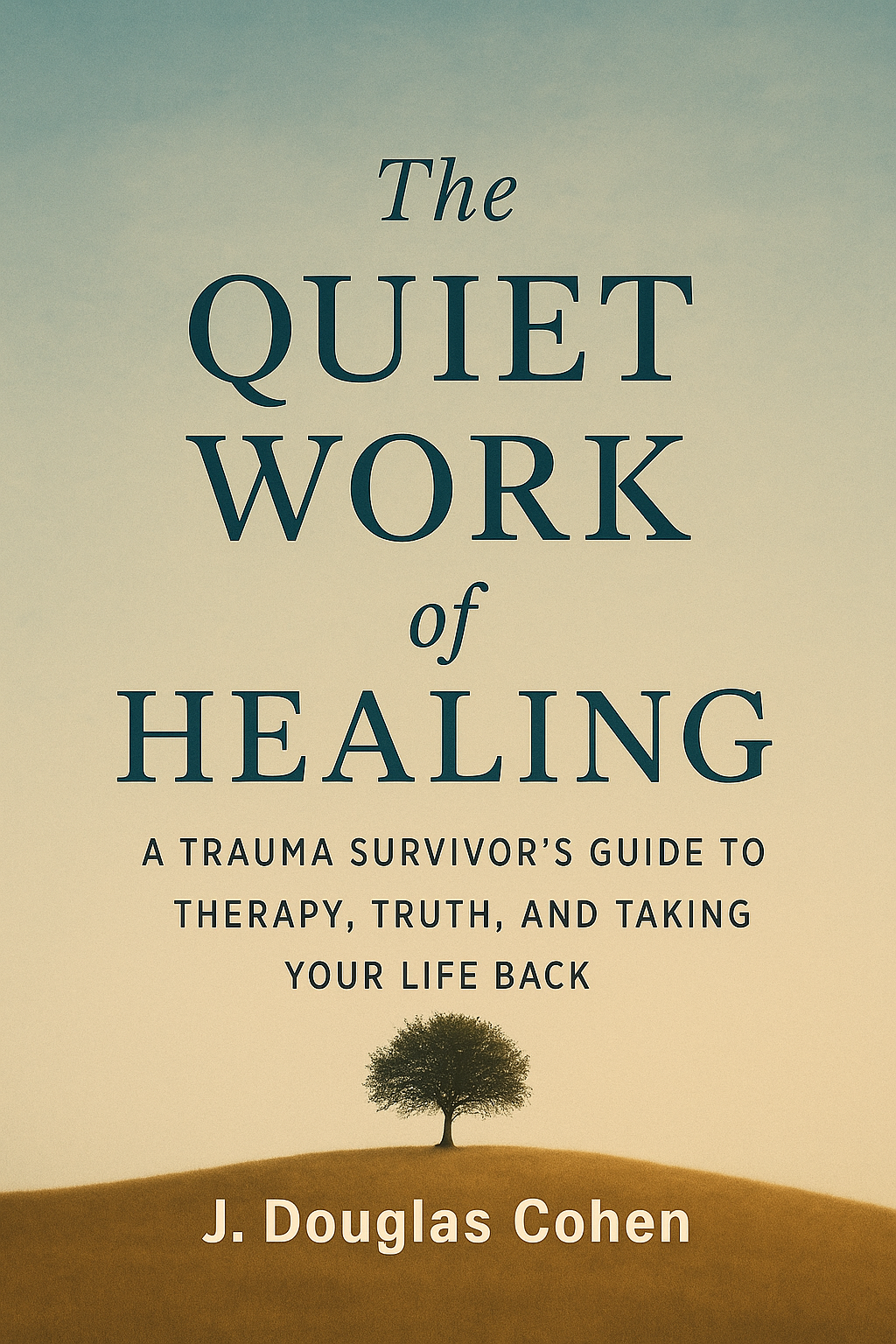
The Quiet Work of Healing: A Trauma Survivor's Guide to Therapy, Truth, and Taking Your Life Back is a 76-page PDF written entirely from personal experience.
It is not a step-by-step clinical protocol.
It is not a workbook full of prompts you'll fill out once and abandon.
It is not written by a therapist telling you how it should go from the outside.
It's part memoir, part guide, part practical toolkit — an honest account of what the work actually looks like. The silence. The fear. The grief. The slow rebuilding. The small, accumulating victories that eventually — unexpectedly — become a life that feels like yours again.
What's inside:
- Finding My Way Back to Myself — where I started, why I went, and what I found waiting in the chair.
- The First Hard Steps: Learning to Sit with Fear — the emotional hangover, the silence, the awkwardness, and why showing up is itself a form of healing.
- Mourning What Was Lost — the grief nobody warned me about. For time, for opportunity, for the version of yourself that never got to exist. And the strange freedom that comes after.
- Rebuilding Confidence, Trust, and Connection — how trust returns. Not in moments — in quiet, cumulative confirmations that eventually become belief in yourself again.
- From Healing to Purpose — when the work stops being about managing what's broken and starts being about building what's possible.
- Living Fully in the Present — how to honor the past without being owned by it.
- Therapy as a Lifelong Compass — why it doesn't end, and why that's not a problem.
- From Surviving to Thriving — what the arc looks like from the other side.
- Practical Tools — how to sit with silence, name anxiety, breathe through it intentionally, grieve without drowning, and find an affordable therapist.
- My Three Biggest Pieces of Advice — what I'd tell myself if I could go back to the beginning.
The guide is $27.
There is nothing else to buy. No upsell. No membership. No follow-on program. You pay $27, you get the PDF immediately, and it's yours.
It's private. The download takes seconds. Nobody follows up.
$27 is less than one therapy session. Less than a dinner out. It's a one-time decision that takes about three seconds.
If you read the first chapter and don't feel like someone finally put words to what you've been living — email me and I'll refund you in full. No explanation required.
Questions:
Is this therapy?
No. This guide is for educational and informational purposes only and is not a substitute for professional mental health care. If you're in crisis, please reach out to a mental health professional or crisis line. The full disclaimer is on page one.
Do I need to currently be in therapy?
No. The guide is useful whether you're in therapy now, have been in the past, or are thinking about starting. Several chapters specifically address what it's like before you begin.
What format is this and how do I get it?
A PDF. You download it immediately after purchase through Gumroad. It's 76 pages — readable in one sitting or slowly over time.
Who is this NOT for?
If you're looking for a structured clinical program with assessments, measurable outcomes, and assigned exercises, this isn't that. If you're looking for an honest first-person account and practical insight from someone who has lived the process, it is.
I've read healing content before and it felt generic. Is this different?
I wrote this partly because I felt the same way. The language that fills most healing content — "your journey," "you deserve peace," "begin to flourish" — doesn't match the experience of actually being in that room. This guide names things that usually don't get named. Whether it's different is for you to decide — and if it isn't, you have my email and my refund promise.
Whether what I share helps you or not — please know this:
You do not need to suffer alone.
Help and hope are out there.
Be brave.
— J. Douglas Cohen